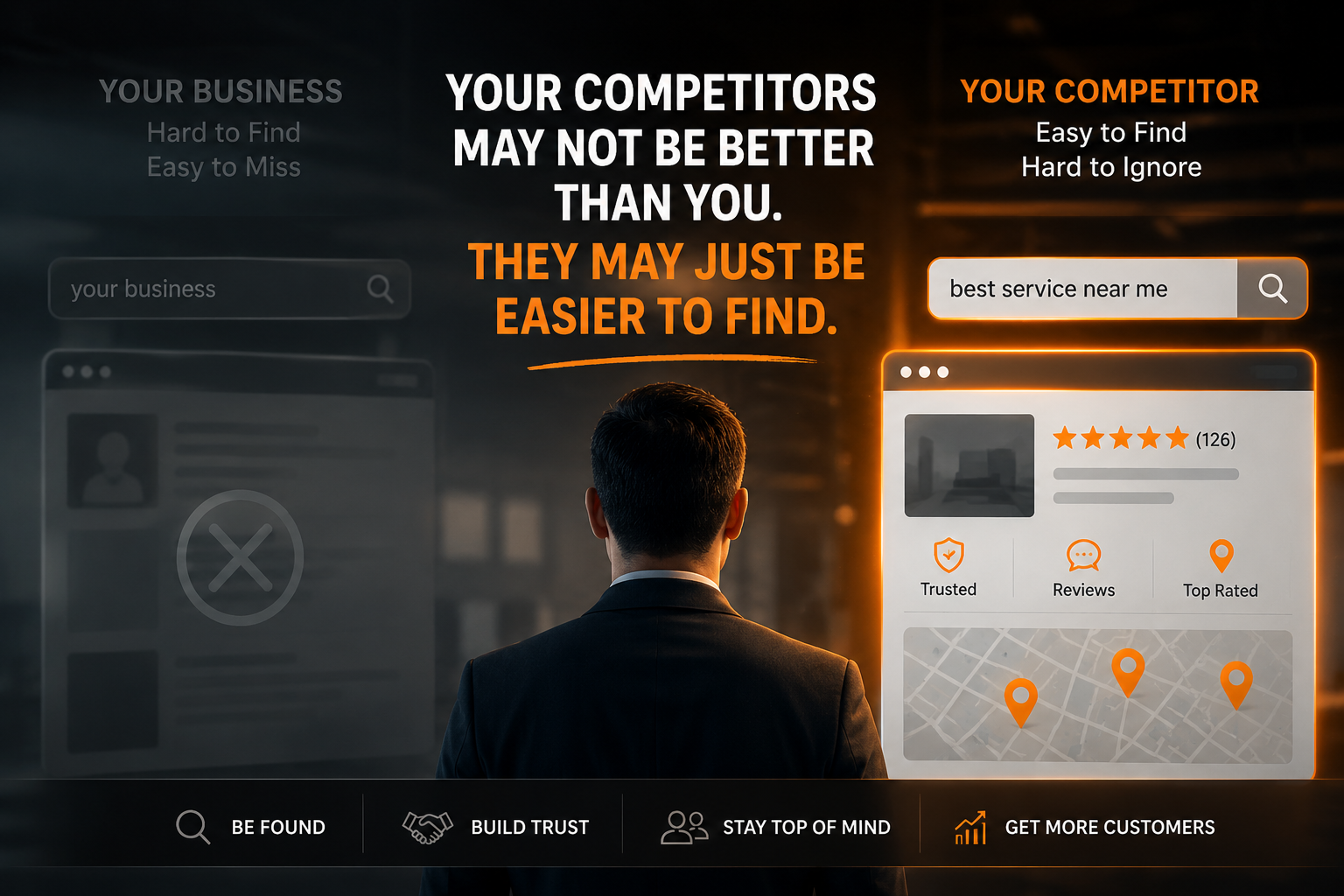
Your Competitors May Not Be Better Than You. They May Just Be Easier to Find
You may have better products. Better service. More experience. Better prices. Even happier customers.
Yet your competitor keeps getting the enquiries.
Why?
Because being good at what you do is only part of winning in today’s market. People need to discover you, understand you, trust you, and remember you before they can become your customers.
A business can be excellent offline and still remain almost invisible online.
This is one of the biggest challenges facing businesses today. Your competitors do not necessarily need to be better than you. They simply need to be more visible when your potential customers are looking for a solution.
Being the Best Isn’t Enough If Nobody Finds You
Imagine someone needs an accountant, renovation contractor, dental clinic, IT company, or digital marketing agency.
They are unlikely to know every business in the market.
Instead, they search online, ask an AI assistant, check Google Maps, browse social media, read reviews, or ask their network for recommendations.
The businesses appearing during that research process immediately have an advantage.
This creates an important distinction:
Business quality and digital visibility are two different things.
You can deliver an exceptional service and still lose customers to a business with a stronger online presence.
Your Customers Are Researching Before They Contact You
The buying process has changed.
Customers rarely go directly from “I need something” to “I’ll contact the first company I see.”
They research.
They compare.
They read reviews.
They look at websites.
They check social media.
They search for answers.
They may even ask an AI platform to recommend suitable businesses.
By the time someone contacts your company, they may already have formed an opinion about your credibility.
That means your digital presence is often doing the first part of your sales job before your sales team ever speaks to the customer.
Your Website Is Only One Part of Your Digital Presence
Many businesses think their online presence means having a website.
A website is important, but it is only one piece of the puzzle.
Potential customers may encounter your business through:
- Google Search
- Google Business Profile
- Social media
- Online reviews
- Industry directories
- Blog articles
- Videos
- Online advertisements
- Referral websites
- AI-powered search and recommendation platforms
Each of these touchpoints contributes to how customers perceive your business.
If your website looks professional but your social media has not been updated for years, that can affect credibility.
If your website is excellent but your Google Business Profile is incomplete, customers may choose another business.
If you have strong reviews but very little useful information online, potential customers may continue searching.
Visibility needs to work as a connected system.
Search Visibility Is About More Than Ranking Number One
Traditional SEO often focused heavily on achieving the number-one position on Google.
Search behaviour has become much broader.
A customer might see:
- A traditional search result
- A featured answer
- A local map result
- A review
- A video
- A social media post
- An AI-generated answer
The opportunity is no longer limited to one position on one search results page.
Businesses need to build digital discoverability across the places where their customers look for information.
This is why modern strategies increasingly consider Search Engine optimization (SEO), Local SEO, content marketing, reputation management, and Generative Engine Optimization (GEO) together.
Your Competitor May Be Winning the Trust Battle
Visibility gets attention.
Trust gets the enquiry.
Suppose two companies appear when a customer searches for a service.
Company A has:
- A modern website
- Recent customer reviews
- Helpful articles
- Clear service information
- Case studies
- Active social media
- Professional photography
Company B has:
- An outdated website
- Very little information
- Few reviews
- No recent content
- An unclear value proposition
Even if Company B provides an excellent service, which company is likely to receive the first enquiry?
Customers use digital signals to reduce uncertainty.
Your online presence needs to answer the question in their mind:
“Can I trust this business to solve my problem?”
Reviews Have Become Part of Your Marketing
Customer reviews are no longer simply something businesses collect after a sale.
They are part of the decision-making process.
Potential customers use reviews to understand:
- What the experience is really like
- Whether the business delivers consistently
- How the company responds to problems
- Whether previous customers were satisfied
- What makes the business different
A strong review strategy should therefore be part of your broader digital marketing strategy.
And importantly, businesses should not simply chase five-star ratings. Authentic customer feedback and thoughtful responses can provide much stronger credibility.
Your Content Can Become Your Sales Assistant
One of the most overlooked opportunities in digital marketing is educational content.
Consider the questions customers ask before purchasing from you.
Those questions can become:
- Blog articles
- Videos
- FAQs
- Guides
- Social media posts
- Case studies
- Comparison pages
- Downloadable resources
For example, instead of simply writing:
“We provide professional accounting services.”
You could answer:
“What should a Singapore SME consider before choosing an accounting service?”
The second approach gives potential customers something useful before asking them to buy.
That is how content begins building a relationship before the first conversation.
AI Is Changing How Customers Discover Businesses
Artificial Intelligence is creating another layer of digital visibility.
People increasingly use AI-powered platforms to ask questions such as:
“What are some good digital marketing agencies for an SME?”
“Which company can help me improve my website?”
“What should I look for when choosing an SEO agency?”
The customer may receive a curated answer rather than a traditional list of ten blue links.
This means businesses need to think beyond conventional keyword rankings.
Clear information, topical authority, structured content, credible references, consistent business information, and a strong digital footprint can all contribute to how a business is understood across modern search environments.
Local Businesses Have an Even Bigger Opportunity
For businesses serving specific locations, local visibility can be extremely valuable.
A customer searching for a service in their area often wants a business they can contact quickly.
Optimising your local digital presence includes more than adding a location to your website.
It involves maintaining accurate business information, developing customer reviews, creating useful local content, and making it easy for customers to contact or visit you.
For many SMEs, improving local discoverability can generate highly relevant leads without competing for broad national search terms.
Don’t Try to Be Everywhere
A common reaction to poor visibility is to create accounts on every platform.
That is rarely the best strategy.
Your customers may not be active everywhere.
Instead, identify where your target audience actually researches businesses and concentrate your resources there.
For a B2B company, LinkedIn and Google may be more valuable than spending most of its effort on entertainment-focused platforms.
For a local consumer business, Google Search, Google Maps, Instagram, Facebook, and customer reviews may be more important.
The goal isn’t maximum presence. It’s maximum relevance.
Consistency Creates Recognition
Imagine seeing a company for the first time on Google.
A few days later, you see its LinkedIn post.
Then you come across one of its articles.
Later, you see a customer review.
Each interaction reinforces the same brand.
This is how digital familiarity develops.
You may not contact the company the first time you see it. But after seeing useful and consistent information several times, the business becomes familiar.
And familiarity can significantly reduce the hesitation involved in making an enquiry.
Measure Visibility by Business Outcomes
Having more followers does not necessarily mean you have a better marketing strategy.
Likewise, website traffic alone does not guarantee growth.
Businesses should connect digital activity to meaningful outcomes such as:
- Qualified enquiries
- Phone calls
- Consultation bookings
- Quote requests
- Online purchases
- Returning visitors
- Conversion rates
- Customer acquisition cost
- Revenue generated
The objective isn’t simply to become visible.
The objective is to become visible to the right people and turn that visibility into business results.
What Should You Do If Your Competitors Are More Visible?
Start with a digital visibility audit.
Look at your business from a customer’s perspective.
Search for your main services.
Search for your competitors.
Look at what appears.
Then ask:
“If I didn’t know my own business, would I choose it based on what I see online?”
Check your website.
Check your Google Business Profile.
Check your reviews.
Check your social media.
Check your content.
Check how clearly you explain your services.
Check whether your business information is consistent.
And most importantly, identify the gaps between your business and the companies receiving the attention you want.
Those gaps represent opportunities.
From Invisible to Discoverable
Digital marketing is not about making your business look bigger than it is.
It is about making the value you already provide easier for the right customers to discover.
Your experience, expertise, customer service, products, and reputation are valuable assets. Digital marketing helps bring those assets into the places where modern customers are making decisions.
Your competitor may not actually be better.
They may simply be easier to find, easier to understand, and easier to trust.
That is a problem that can be changed.
At Digital Nova, we help businesses strengthen their digital presence through SEO, Local SEO, content marketing, website optimisation, social media marketing, AI-focused search strategies, and data-driven digital marketing. The goal is not simply to generate more online activity. It is to help the right customers discover your business, understand your value, and take the next step.