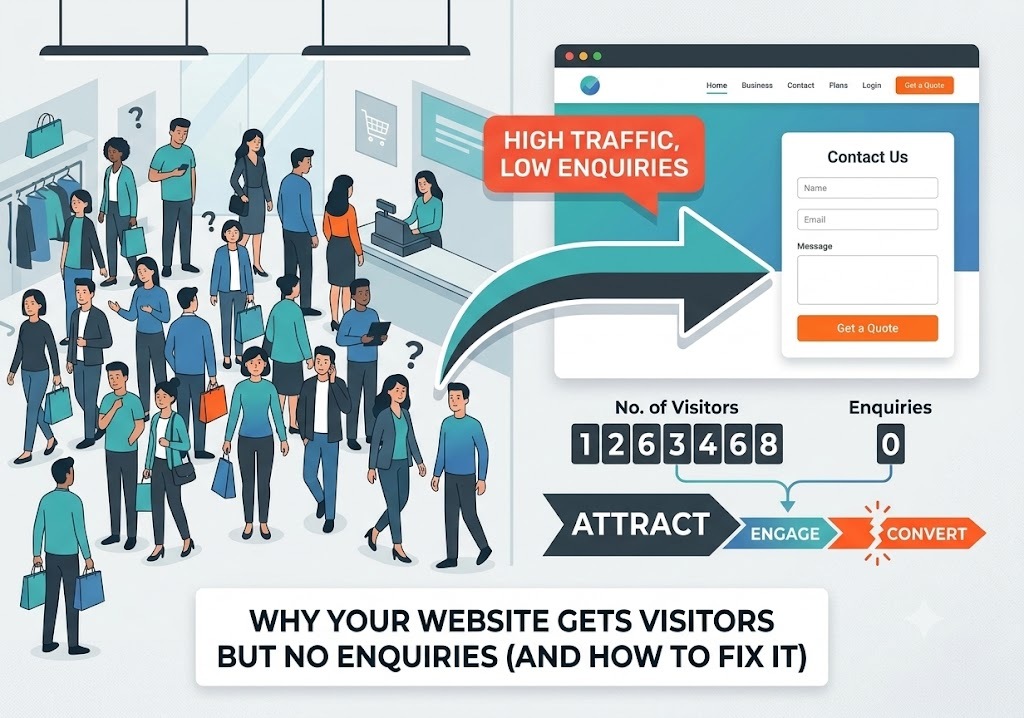
Why Your Website Gets Visitors But No Enquiries (And How to Fix It)
Many business owners celebrate when their website traffic increases. Seeing hundreds or even thousands of visitors each month feels like progress. But there is one question that matters far more than visitor numbers:
Are those visitors becoming customers?
A website that attracts traffic but generates few or no enquiries is like a retail store filled with shoppers who leave without making a purchase. While getting visitors is important, converting those visitors into leads and customers is what drives business growth.
If your website is not delivering enquiries consistently, the issue is rarely a lack of traffic. More often, it is a combination of user experience, messaging, trust, and conversion strategy.
Traffic Without Conversions Is a Common Business Challenge
Many businesses invest heavily in Search Engine Optimization (SEO), Google Ads, social media marketing, and content creation, only to discover that enquiries remain low.
This usually indicates that visitors are interested enough to click, but something on the website prevents them from taking the next step.
Instead of asking, “How can I get more traffic?”, ask:
- Why are visitors leaving?
- What information are they looking for?
- What is stopping them from making contact?
- Is my website making the decision easy?
Answering these questions often leads to significant improvements in lead generation.
Your Homepage Has Only Seconds to Make an Impression
Research consistently shows that visitors form an opinion about a website within seconds.
When someone lands on your homepage, they should immediately understand:
- What your business does
- Who your services are for
- How you solve customer problems
- Why they should choose you
- What action they should take next
If these answers are unclear, visitors will often leave before exploring further.
A clear value proposition is one of the most effective ways to improve conversions.
Every Page Should Have a Purpose
Many websites contain attractive designs but lack direction.
Each page should encourage visitors to take a specific action, whether it is:
- Requesting a quotation
- Booking a consultation
- Downloading a guide
- Calling your business
- Sending an enquiry
- Subscribing to a newsletter
Without clear Calls-to-Action (CTAs), visitors may simply browse and leave.
Trust Is Built Before the First Conversation
Before contacting your business, potential customers are looking for reasons to trust you.
Strong trust signals include:
- Customer testimonials
- Case studies
- Industry certifications
- Awards and recognition
- Client logos
- Real team photos
- Transparent contact information
- Frequently Asked Questions
These elements reduce uncertainty and help visitors feel more confident about reaching out.
Make It Easy to Contact You
Some businesses unintentionally create barriers by using long forms or hiding their contact details.
Improve your conversion opportunities by offering multiple ways to connect:
- Simple enquiry forms
- Click-to-call phone numbers
- WhatsApp chat
- Email contact
- Online appointment booking
- Live chat support
The easier it is to make contact, the more enquiries you are likely to receive.
Mobile Experience Can Make or Break Conversions
A significant percentage of website visitors now browse using smartphones.
A website that performs well on desktop but poorly on mobile can lose valuable business opportunities.
Your mobile website should provide:
- Fast loading speeds
- Readable text
- Easy navigation
- Clickable buttons
- Mobile-friendly forms
- Responsive layouts
A smooth mobile experience increases both customer satisfaction and search visibility.
Speed Matters More Than You Think
Visitors expect websites to load almost instantly.
Slow-loading pages often result in:
- Higher bounce rates
- Lower engagement
- Reduced conversions
- Poor user experience
- Lower search rankings
Optimising images, improving hosting performance, and reducing unnecessary scripts can dramatically improve website speed.
Your Content Should Guide, Not Confuse
Many businesses focus on describing themselves instead of explaining how they help customers.
Effective website content should:
- Address customer challenges
- Explain solutions clearly
- Highlight measurable benefits
- Use simple language
- Answer common questions
- Remove uncertainty
Customers are less interested in what your business does and more interested in what your business can do for them.
Measure What Visitors Actually Do
Website analytics reveal valuable insights into user behaviour.
Businesses should regularly monitor:
- Most visited pages
- Exit pages
- Scroll depth
- Button clicks
- Form submissions
- Session duration
- Navigation paths
Understanding visitor behaviour helps identify where potential customers lose interest.
Test, Improve and Repeat
Website optimisation is an ongoing process rather than a one-time project.
Simple improvements such as changing a headline, repositioning a contact form, simplifying navigation, or improving button text can significantly increase conversion rates.
Regular A/B testing helps businesses make decisions based on evidence instead of assumptions.
Think Beyond the Website
A successful customer journey often begins before someone visits your website.
Your online presence should work together across multiple channels:
- Google Search
- Google Business Profile
- Email marketing
- Online reviews
- Educational blog content
Consistent messaging across these channels builds familiarity and trust before a visitor even reaches your website.
Focus on Quality Leads, Not Just More Visitors
More traffic does not always mean better results.
A smaller number of highly targeted visitors who genuinely need your products or services will often generate more enquiries than thousands of untargeted website visits.
Digital marketing should focus on attracting the right audience, delivering the right message, and making it easy for them to take action.
What This Means for Your Business
Your website should be more than an online brochure. It should function as your hardest-working salesperson, available around the clock to educate visitors, build trust, and convert interest into enquiries.
If your business is attracting visitors but not generating enough leads, the solution may not be increasing your marketing budget. It may be improving the experience your website provides.
At Digital Nova, we help businesses transform underperforming websites into lead-generating assets through conversion-focused web design, SEO, user experience optimisation, AI-powered content strategies, and performance analytics. By combining data, creativity, and proven digital marketing techniques, we help businesses turn website traffic into measurable business growth.




Leave a comment